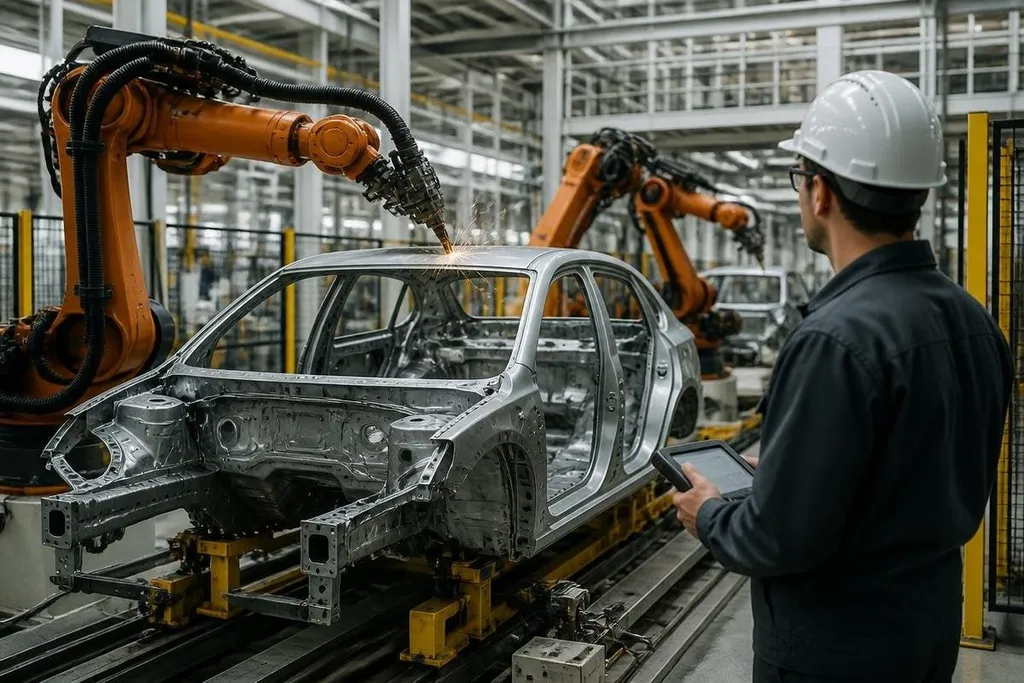
Automotive robots handle the same weld, paint pass, or part move thousands of times. They can raise output and reduce exposure to heat, fumes, and heavy loads, but each task still needs careful setup, guarding, and human oversight.
Quick read
- Robot arms suit repeatable work with fixed positions
- Vision sensors help check parts, but they can miss defects
- Safety design and maintenance decide whether a cell works well
Where automotive robots help
A robot arm follows programmed joint paths, so it can repeat a weld or adhesive bead with steady movement. That repeatability helps keep the gap, angle, and travel speed close from one vehicle body to the next.
The same setup can move parts between fixtures, presses, and conveyors. That reduces the need for people to carry heavy panels or reach into hot areas. The gain comes from matching the robot to a task with stable locations and a known cycle.
Painting brings another use. The arm can keep the spray gun at a set distance from the body, which helps spread paint across large panels. The result still depends on paint flow, air pressure, nozzle wear, and the shape of the part.
Inspection uses cameras, light sources, and software to check items such as bolt presence, panel gaps, or surface marks. A camera can check every part in the cell, but it only sees the defects that its lighting and software can detect.
The limits behind the output
Automotive robots work best when parts arrive in the same position each time. A bent bracket, a loose fixture, or a blocked sensor can stop the cell or send the arm along a path that no longer fits the part.
That makes setup work important. Engineers need to set robot paths, test the end effector, check sensor readings, and confirm that the cell reacts correctly when a part is missing. An end effector is the tool attached to the arm, such as a gripper, welder, or paint gun.
Changeovers can also take time. A line built for one body style may need new fixtures, tools, software, and safety checks before it can handle another. A robot does not remove that work; it moves the work into planning, programming, and service.
Maintenance adds another cost. Motors, gearboxes, cables, grippers, nozzles, and cameras can wear or lose calibration. A small fault may stop one arm, while a shared conveyor or safety circuit can hold up the whole cell.
A camera that loses calibration can change what the robot sees near a worker or vehicle. Reports from Robot24 on automotive automation can place the robot, plant, test date, and safety result beside that risk. The next check is how the cell protects people when a sensor or motor fails.
Safety is part of the machine
A robot arm can move with enough force to injure someone who enters its work area. A safe cell uses physical guards, gates with interlocks, emergency stops, and safety-rated scanners where people and robots work near each other.
The controls must match the job. A slow teaching mode may allow a technician to guide an arm during setup, while normal production needs restricted access and tested stop functions.
Lockout and tagout procedures also matter during service because stopping a program does not remove stored electrical, pneumatic, or mechanical energy.
Training has a direct effect on safety. Operators need to know what each stop does, which faults require a technician, and when a restart needs a full area check. A rushed restart can turn a small production fault into a physical hazard.
A practical buying and setup check
Before choosing an automotive robot cell, check these points:
- Name the task: Record the part, tool, cycle, reach, payload, and required repeatability.
- Check the parts: Test position changes, surface variation, loose items, and damaged components.
- Plan the cell: Mark guards, gates, scanners, stops, service access, and nearby worker paths.
- Measure the changeover: Count the fixtures, programs, tools, and checks needed for the next model.
- Price the service: Include spare cables, grippers, sensors, software support, training, and planned downtime.
- Set the proof test: Define the output, defect rate, stop response, and recovery steps before production starts.
I'd choose a robot for a repeatable task with stable parts and a clear safety case, not for work that changes by hand from one vehicle to the next.
The next useful question is specific: can the cell keep its required cycle and defect rate after a tool change, a sensor fault, and a full maintenance stop?